We’ve been hearing for several years about an FDA proposal to overhaul its device regulatory framework with ISO 13485, potentially the most ambitious FDA undertaking in a quarter century. Those who don’t follow these things might find the subject terminally boring, but such a change could be a massive headache for industry, although it doesn’t have to be if the FDA can get the temperature of this regulatory porridge just right.
As we’ve all undoubtedly noticed, the FDA commissioner’s chair is conspicuously absent a duly deputized occupant, and a number of reasons have been offered to explain that. Some of these, such as the COVID-19 pandemic, will eventually give way, but some of the drag is unrelated to temporary issues, which is the more worrisome part of the problem.
The truth that every action has a reaction is being proven again in the public square of the U.S. as the shrill, endless clamor of politicians hoping to score against their opponents via health care issues or accomplishments threatens to undermine confidence in the FDA, the products it approves and even the guidance offered by the Centers for Disease Control and Protection (CDC). In the past, politicians from both parties blamed “greedy” biopharma companies and self-appointed social influencers for patients refusing to fill prescriptions, get tested or be immunized. Now they have themselves to blame.
It’s mighty tempting to run a little play on words with regard to eyesight in this new year, but I need reading glasses, so far be it from me to pepper a blog with wisecracks about 20-20 vision in 2020. Still, there are a few things to look forward to in this new year, including some great expectations and one or two desperate hopes.
There are a lot of ways to save money without going bankrupt in the process, but health care in the U.S. certainly has not lent itself to that sort of thing. Still, there’s a big opportunity to do just that if one demonstrates an interest in sleep, a subject about which there is little evident interest in Washington, D.C., or in the boardrooms of med tech firms. According to a study by the Rand Corporation, data from five OECD nations suggest that those who sleep...
Now that the existing inventory of FDA-approved transcatheter aortic valve replacement (TAVR) devices has received a green light for patients at low surgical risk, it’s tempting to think this device type has pretty much conquered all that lay before it. That’s not the case, however, as the question of bicuspid valve might be answered in a way that gives Edwards Lifesciences and Medtronic another sizeable patient population for their TAVR offerings. As is widely known, the FDA recently approved two TAVR devices each by Medtronic...
We who write about medical devices rarely suffer for content, but the month of May was unusually cooperative even by our standards. Following are two stories about medical devices that either emerged or resurfaced in the merry month of May, each of which involves a cardiologist and what some of us now think of as not-so-social media. Cabana and the case for catheter ablation We’ve all heard at least a little of the noise about catheter ablation for atrial fibrillation over the years, including assertions...
Life has a lot of unknowns, and one of the big unknowns for 2019 is what the FDA will look like now that Scott Gottlieb has returned to the American Enterprise Institute. Norm Sharpless of the National Cancer Institute has been named the acting FDA commissioner – which by itself doesn’t mean a whole lot, other than that he has to be considered a lead candidate for the job – but the difficulty in knowing where the agency would go in terms of policy under...
Now that the dust is still swirling over the news that Scott Gottlieb will leave the FDA, it’s time to conduct a hasty post-mortem on his tenure at the agency, or perhaps more to the point, his lack of tenure. While it’s tempting to frame the question that way, it might be more salient to ask about the nature of the FDA commissioner’s job and whether it is still sufficiently politically insulated to do what is asked of it. Gottlieb had been on the job...
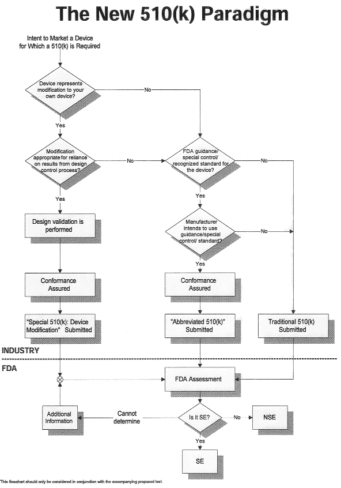
A now-little known band called the Classics IV made a big splash in 1968 when their Hallowe’en love song “Spooky” charted at #3 on the U.S. Billboard Hot 100, and eerie though it may sound, there might be a lesson in there for the FDA half a century later. Sound preposterous? Read on and decide for yourself. House (and Senate) on Haunted Hill As we’ve all seen, the FDA has proposed to pull the substantial equivalence standard for 510(k) filings, but the agency also acknowledged that these 510(k) submissions have ballooned over the past decade or so. Some of that...
 RSS
RSS